OPEN 2025 SUMMARIES BELOW THIS HIGHLIGHT GRAPHIC

OPEN 2025 SUMMARIES BELOW THIS HIGHLIGHT GRAPHIC
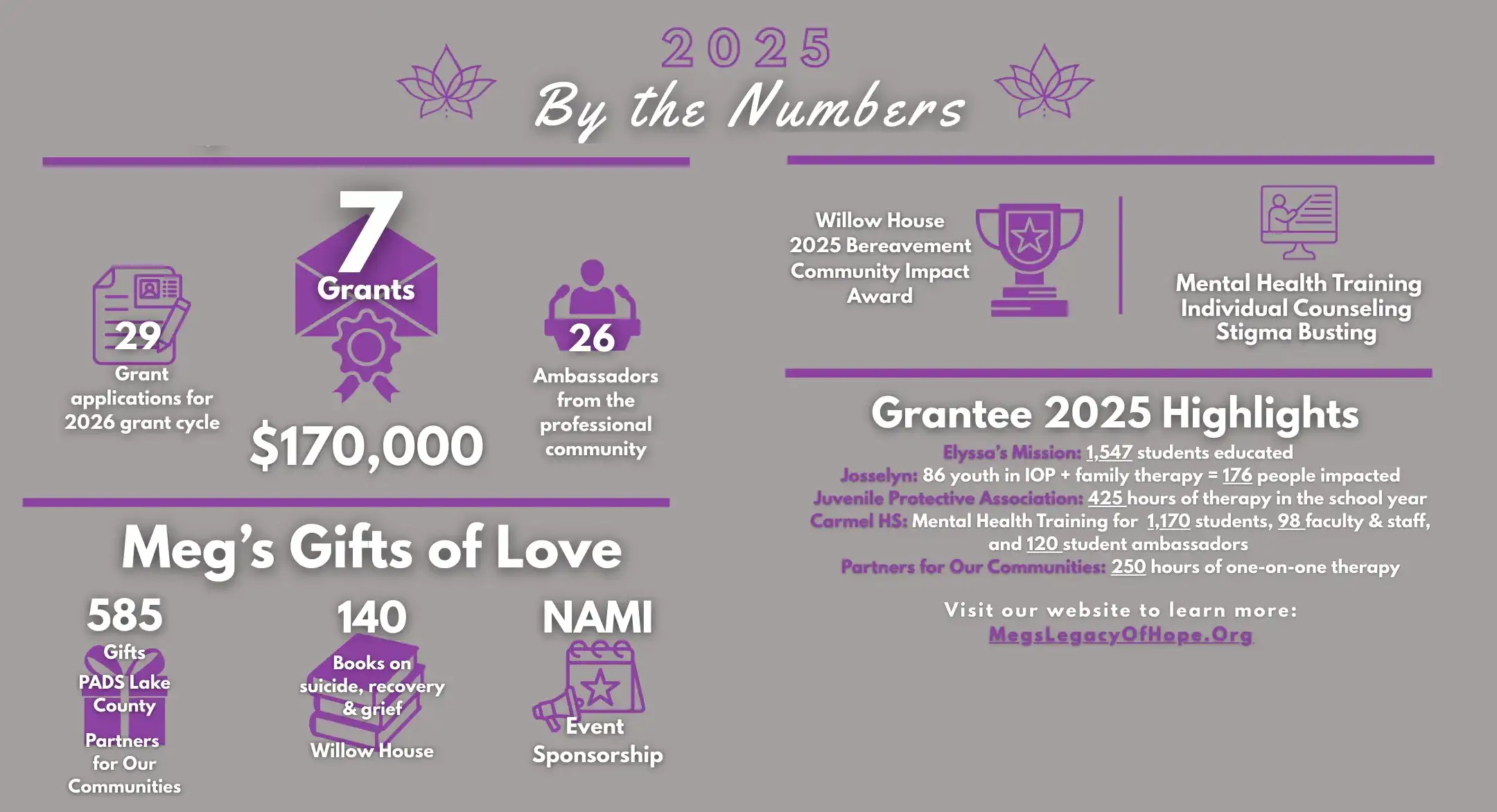
Grant: Provide evidence-based SOS Signs of Suicide program to 7 new middle schools or high schools for the 2025-2026 school year.
Action: Teach students action steps (ACT) if they are concerned about self or friends: ACKNOWLEDGE warning signs, CARE for them, TELL a trusted adult
Student story:
“In middle school I was a victim of bullying and struggled with OCD and depression. By the end of eighth grade, I had turned to self-harm and was consumed by suicidal thoughts. Certain comments made by even my best friends at the time made me feel as if I lacked value and was better off not being alive. I kept the way I felt to myself and refrained from telling anyone close to me because I was afraid of how people would react if I said something. Stigmas in society surrounding mental health make it a taboo subject to discuss, even in private conversations.
In my freshman year, I was shown the SOS Signs of Suicide for High School videos and taught the ACT acronym. At the time, I was still grappling with the idea of telling someone the way I was feeling. I was afraid and unsure if my parents would accept the way I felt. I was also unaware of the seriousness of my feelings. However, after watching the videos, I made up my mind to tell my parents that I was having suicidal thoughts and was unable to see my worth in the world. I took action for myself.
I was able to start seeing a licensed therapist and psychiatrist who together helped me understand my emotions. They helped me improve my communication with my parents and find my worth again. The program ultimately inspired me to get help for myself, and for SOS, I will be forever grateful.”
Grant: Provides funding for Josselyn’s Intensive Outpatient Program (IOP), which delivers a high level of care in group settings, located in a welcoming, youth-focused space in Grayslake.
Action: Trauma-informed and evidence-based treatment is provided for children and teens for 6-8 weeks of intensive programming, special skills curriculum plus family learning sessions.
Client Comment:
“Josselyn is a place where no judgment is found. You can share your deepest, darkest secrets and they’ll still support you no matter what.”
Susan Resko, CEO & President:
“We are helping participants build essential coping skills for challenges like anxiety, depression, impulsivity, and self-injury, while aiming to prevent hospitalization. We are deeply grateful to the Megan Butz Legacy of Hope for their generous grant, which helps make this level of care possible.”
Grant: Funds school-based therapy for underserved children in Chicago neighborhoods.
Action: Bring mental health services to struggling communities, so no child struggles alone.
Client Comments:
Joanie: “Sometimes when you’re with other people it’s hard to express your feelings and it’s important to have a place for that.”
Luis: “I can talk about situations and if I don’t talk about bad situations, I’ll probably do something I’ll regret later.”
Rolando: “Therapy made me more confident. It made me less shy. I’m an upstander not a bystander.”
Grant: Provides mental health services for under-resourced students living in poverty.
Action: The Skyward Bound program reaches young adults facing serious mental health challenges. By offering accessible, culturally responsive counseling services, POC can intervene early, reduce the risk of suicide, and support long-term healing.
Impact Story:
At 21, Marisol felt like she was barely holding on. As a first-generation college student from a low-income background, she carried not only her own dreams but the unspoken expectations of her entire family. Marisol struggled silently with severe anxiety and depression, intensified by the cultural tension of feeling “not American enough” at school and “not traditional enough” at home. Her family dismissed therapy as unnecessary and shameful, leaving her isolated and confused.
When suicidal thoughts became overwhelming, Marisol reached out—quietly, and anonymously—to POC who offered free, culturally-sensitive counseling through its Skyward Bound Program. It was the first time someone truly listened without judgment. Through regular sessions, she began to understand how cultural identity, trauma, and stigma had shaped her mental health. She learned coping skills, gained confidence, and found a community that affirmed her experiences.
Access to mental health services didn’t just help Marisol survive – it helped her build a future. Today, she’s mentoring others and advocating for mental wellness in underserved communities, showing firsthand how critical—and life-saving—mental health support can be.
Grant: Provides grief support and education for youth and family grieving the death of a parent/sibling/child.
Action: Offer a safe place and community for bereavement in the Peer Support Group, especially Survivors of Suicide (SOS), to help prevent the risk of suicide, substance use, and other risk factors that young people may face from unattended grief.
Client Comment:
When my 18-year-old daughter died by suicide in November of 2021, I didn’t know what I was going to do. I felt completely lost and like my life was over, too. People around me tried to help by suggesting I journal, read, or exercise. But none of it felt like enough. A friend encouraged me to find a support group at Willow House which helped me find tools to process my grief. I discovered that it is possible to feel better. My grief is still here, but I feel stronger now. These meetings have made a lasting difference in my mental health and overall quality of life.
Grant: Provides mental healthcare counseling to underserved, even if unable to afford services.
Action: With two-thirds of clients under the age of 25, this funding will have a direct impact on children and adolescents who might otherwise go without care in Lake County.
Client Story:
At 15, Sofia faced more challenges than many do in a lifetime. She came to YFC with a history of complex trauma, self-injury, suicidal ideation, and an eating disorder. Over the past three years, she’s been hospitalized multiple times, often cycling in and out of care within just a few weeks. Because of the severity of her symptoms, she had been turned away from several outpatient therapists and psychiatric hospitals.
At YFC, she wasn’t turned away. She was met with consistent, high-quality care. Given her needs, Sofia began meeting with her therapist twice a week. That support helped her stay out of the hospital for seven weeks—her longest stretch in years. It was the first time she had the opportunity to begin addressing her trauma in an outpatient setting without being interrupted by a hospitalization.
Sofia has made progress. She’s using coping strategies to manage self-harm urges and suicidal thoughts. Sofia has said she feels supported and plans to continue working with her YFC therapist.
Support from Meg’s Legacy makes this kind of continuity possible. It ensures that young people like Sofia—who might be out of options elsewhere—can get the care they need to stabilize, heal, and begin building a more hopeful future.
Grant: Develop a new, comprehensive mental health and wellness education program for the entire student body of 1200, plus faculty training by Josselyn called “Mental Health First Aid”.
Action: Meg’s Legacy sponsored motivational speaker Darryl Bellamy, who challenged students to confront their fears with courage and embrace life’s challenges with confidence. Students were encouraged to recognize their inner strength and build resilience.
Student Comments:
“I learned that most fears I have, others have them too.”
“Fear is natural, but we need to learn to manage it.”
“We shouldn’t be afraid to express ourselves.”
“Everyone has fears and you are not alone. It’s ok to be afraid.”